Research Peptide Storage in the Netherlands 2026
Short answer: Store lyophilised research peptides sealed, dry and dark at 2 to 8 °C for routine use or at -20 °C for long-term storage, and let the vial reach room temperature before opening so no condensation forms on the powder. After reconstitution with bacteriostatic water, keep the solution refrigerated at 2 to 8 ...
 The P&P Lab12 min read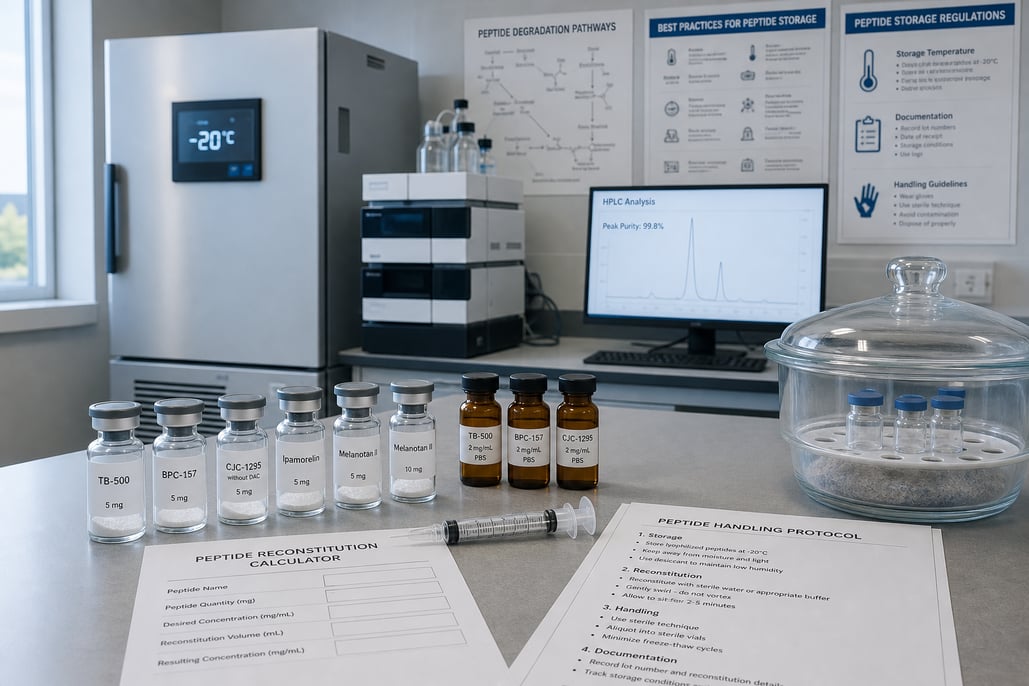
Short answer: Store lyophilised research peptides sealed, dry and dark at 2 to 8 °C for routine use or at -20 °C for long-term storage, and let the vial reach room temperature before opening so no condensation forms on the powder. After reconstitution with bacteriostatic water, keep the solution refrigerated at 2 to 8 °C, divide into single-use aliquots if it must be frozen, and never refreeze a thawed aliquot. Buying from EU stock shortens transit and avoids customs holds. In the Netherlands, a reagent presented strictly for laboratory use is a chemical; anything presented for human use is an unlicensed medicine.
Key Takeaways: Research Peptide Storage in the Netherlands 2026
- Lyophilised peptides remain stable for months to years when stored at -20°C in sealed vials protected from moisture and light.
- Reconstituted peptide solutions degrade faster than dry powders and require refrigeration at 2-8°C for short-term laboratory use.
- Freeze-thaw cycles damage peptide integrity through ice-crystal formation and pH shifts; single-use aliquots eliminate repeated cycling.
- Dutch law judges a peptide by how it is presented: a laboratory reagent without health claims is a chemical, while anything presented for human use is an unlicensed medicine under the Geneesmiddelenwet, and the IGJ has said in 2026 that a research label alone does not change that.
- Vitality Peps dispatches batch-tested research compounds from EU stock, with the analysis record for each batch published before purchase.
Why Proper Peptide Storage Matters for Research Outcomes
Peptides are chains of amino acids linked by amide bonds. Their integrity in any assay depends on preserving that covalent backbone, the intended side-chain chemistry, and any higher-order conformation relevant to the study.
When storage conditions fail, degradation pathways accelerate. Hydrolysis breaks the backbone. Oxidation alters methionine, cysteine, and tryptophan residues. Aggregation renders samples unusable. The result: compromised data, wasted material, and experiments that need repeating.
This guide covers the storage protocols, handling practices, and regulatory context that Dutch researchers need to maintain sample quality from receipt through the final assay.
How Should Lyophilised Peptide Powders Be Stored?
Lyophilisation removes water from a frozen peptide solution by sublimation under vacuum. The result is a dry, amorphous solid in which molecular mobility and hydrolytic reactions are strongly suppressed.
This low-moisture state is the most stable presentation for long-term storage. The standard protocol: keep lyophilised material at -20°C in the original sealed vial. For archival storage of sensitive sequences, -80°C extends stability further.
Temperature Requirements for Powder Vials
At -20°C, lyophilised peptides typically remain stable for 3 months to 5 years, depending on the sequence. Cysteine-containing peptides and those with asparagine near glycine residues degrade faster and benefit from colder storage.
The freezer must be a manual-defrost unit. Frost-free freezers cycle through temperature fluctuations that stress samples over time. A dedicated laboratory freezer with temperature logging is the standard approach.
Protecting Vials from Moisture and Light
Moisture is the enemy of lyophilised material. Water acts as a reactant in backbone hydrolysis and increases molecular mobility in solids. Keep vials in a desiccator or sealed secondary container with fresh desiccant.
Light drives photochemical oxidation, particularly in peptides containing tryptophan, tyrosine, and histidine. Amber vials, foil wrapping, or storage in opaque containers mitigate this exposure. Vitality Peps ships research peptides in sealed vials designed for laboratory storage.
The Room-Temperature Equilibration Step
Before opening a cold vial, allow it to reach room temperature while still sealed. This prevents condensation of ambient humidity onto the chilled powder surface.
Opening a cold vial exposes the contents to warm, moist air. Water condenses on the powder. That water reintroduces the hydrolysis risk the lyophilisation process was designed to eliminate. A 15-30 minute equilibration period in a desiccator is standard practice.
What Is the Correct Reconstitution Protocol for Research Peptides?
Reconstitution dissolves lyophilised powder in a suitable solvent to form a working solution. The chemistry of this step centres on solubility and stability.
Selecting the Right Solvent
Hydrophilic peptides dissolve readily in aqueous solvents. Bacteriostatic water (0.9% benzyl alcohol) is the standard choice for most research applications. The preservative inhibits microbial growth during the solution's working life.
Hydrophobic sequences may require a co-solvent. A small fraction of dimethyl sulfoxide (DMSO) or dimethylformamide (DMF) can achieve dissolution where water alone fails. Note: DMSO-containing solutions should not be stored frozen, as DMSO crystallisation can damage peptide structure.
Acidic peptides dissolve best in basic buffers. Basic peptides dissolve best in acidic buffers. The Vitality Peps research guides include solubility notes for specific compound classes.
Step-by-Step Reconstitution Procedure
1. Allow the sealed vial to equilibrate to room temperature in a desiccator.
2. Draw the calculated volume of solvent into a sterile syringe.
3. Insert the needle through the stopper at an angle. Direct the solvent stream down the inside wall of the vial, not onto the powder cake.
4. Swirl gently until the solution is clear. Do NOT shake. Vigorous agitation promotes foaming, air-liquid interfacial stress, and aggregation.
5. If the powder does not dissolve completely, allow the vial to stand for several minutes. Add more solvent only if necessary.
Calculating Concentrations with a Reconstitution Calculator
The Vitality Peps reconstitution calculator converts vial mass and diluent volume into a concentration and syringe mark for research measurement. This is a calculation tool, not a recommendation for any specific application.
Volume per measurement (ml) = Desired amount (mcg) ÷ (Peptide mass (mg) ÷ Water volume (ml) × 1000)
How Do Freeze-Thaw Cycles Damage Peptide Solutions?
Once reconstituted, a peptide exists in a hydrated state where degradation pathways proceed faster than in the dry powder. Freezing and thawing that solution introduces additional stressors.
The Mechanisms of Freeze-Thaw Degradation
Each cycle exposes the peptide to ice-crystal formation. Growing ice concentrates solutes in the remaining liquid phase. Local pH shifts occur as buffer components freeze out at different rates.
Interfacial stress at the ice-liquid boundary promotes physical denaturation. Aggregation products accumulate with each cycle. After 3-5 freeze-thaw events, many peptides show measurable activity loss or visible precipitation.
Single-Use Aliquots Eliminate Repeated Cycling
The standard mitigation: divide a reconstituted solution into single-use aliquots before freezing. Each portion is thawed once for use. The remaining material stays frozen.
Calculate aliquot volumes based on expected usage per experiment. Use sterile microcentrifuge tubes or cryovials. Label each aliquot with peptide name, concentration, date, and lot number.
Thawing Protocols That Preserve Integrity
Thaw aliquots gently by allowing them to reach refrigerator temperature (2-8°C) or ambient temperature. Rapid heating accelerates degradation. Do not thaw in a water bath above 37°C.
Mix by gentle inversion or swirling, not vortexing. Use the aliquot immediately or hold it refrigerated for no more than the validated working period for that specific peptide.
What Are the Main Degradation Pathways Affecting Research Peptides?
Understanding degradation chemistry informs storage decisions. Peptides degrade through chemical and physical routes, each influenced by environmental variables.
Chemical Degradation Pathways
Hydrolysis cleaves the amide backbone, producing fragments. This reaction requires water and accelerates at pH extremes and elevated temperatures.
Deamidation converts asparagine to aspartate (or isoaspartate) and glutamine to glutamate. This alters charge and can affect receptor binding. Asparagine-glycine motifs are particularly susceptible.
Oxidation targets methionine (forming methionine sulfoxide), cysteine (forming disulfides or sulfenic acids), and tryptophan (forming various oxidation products). Oxygen, light, and metal ions catalyse these reactions.
Disulfide scrambling in cysteine-containing peptides produces incorrect pairing, changing structure and potentially function. Degassing buffers before reconstitution reduces this risk.
Physical Degradation Pathways
Aggregation assembles peptide molecules into soluble or insoluble clusters. Once aggregated, material is typically unusable for most assays.
Adsorption onto container surfaces reduces solution concentration over time. Low-bind plastics or silanised glass vials reduce this loss for dilute solutions.
Fibrillation produces ordered beta-sheet structures. Certain sequences are prone to this pathway, particularly at high concentrations or after agitation.
What Dutch Regulations Apply to Research Peptide Storage and Handling?
The Netherlands applies three primary laws to peptide compounds. Classification depends on how the material is presented, labelled, and intended to be used.
The Geneesmiddelenwet (Medicines Act)
The Geneesmiddelenwet defines when a substance becomes a medicinal product. The threshold: presentation as suitable for treating or preventing disease, or administration to restore, correct, or modify a physiological function.
A peptide sold exclusively as a laboratory reagent, without health claims or instructions for human use, is presented as a chemical rather than a medicine. The Inspectie Gezondheidszorg en Jeugd (IGJ) enforces these rules and stated in 2026 that a "research purposes" label does not protect a seller who presents products for human use; see our full article on the legal status of research peptides in the Netherlands. The CBG-MEB (Medicines Evaluation Board) handles licensing for actual medicinal products.
The Opiumwet (Opium Act)
The Opiumwet prohibits substances on List I (hard drugs) and List II (soft drugs). Standard research peptides including BPC-157, TB-500, GHK-Cu, Ipamorelin, and growth hormone secretagogues do not appear on either list as of 2026.
Researchers should verify current scheduling before ordering any novel compound. Lists are subject to update.
The Warenwet (Commodities Act)
Research chemicals that are not presented as medicines and are not scheduled substances are regulated as chemicals (Warenwet, EU CLP and REACH) rather than as medicinal products. Whether a specific product is a chemical or an unlicensed medicine depends on its presentation, which is why the wording on a supplier's page matters as much as the label on the vial. See the current research peptides catalogue for how products are presented.
EU CLP (Classification, Labelling, Packaging) and REACH chemical-safety regulations may also apply depending on the specific substance and quantity.
Institutional Compliance for Dutch Research Facilities
Researchers at Dutch universities (TU Delft, Utrecht, Leiden, Amsterdam UMC, Erasmus MC, Groningen), TNO, or pharmaceutical companies should maintain procurement documentation including: lot-matched Certificates of Analysis, commercial invoices, and research-use-only labelling verification.
How Does EU-Domestic Dispatch Affect Peptide Stability?
Peptides are temperature-sensitive compounds. Transit time and handling conditions during shipping directly affect the material that arrives at your laboratory.
Cold-Chain Logistics from EU Warehouses
Suppliers with EU-based warehouses ship to Dutch destinations as internal-market movements. No customs clearance delays. Typical delivery: 2-4 business days from Western and Central European dispatch points.
Vitality Peps maintains an EU warehouse with cold-chain handling protocols. Material is temperature-controlled until dispatch. Shorter transit times mean less opportunity for temperature excursions to affect sample quality.
Receiving and Inspecting Peptide Shipments
Upon receipt, inspect packaging for damage or evidence of temperature excursion (melted cold packs, condensation inside packaging). Transfer vials to appropriate storage immediately.
Review the Certificate of Analysis against the lot number on the received vials. The COA documents purity (HPLC), identity (mass spectrometry), and any additional testing parameters relevant to your research application.
What Storage Conditions Apply After Reconstitution?
Reconstituted peptide solutions are inherently less stable than lyophilised powders. Water is now available as a reactant, and molecular mobility increases.
Refrigerated Storage for Working Solutions
Hold reconstituted solutions at 2-8°C for near-term use. Stability varies by sequence, but 2-4 weeks is a typical working window for most peptides under refrigeration.
Protect from light. Use amber vials or wrap in foil. Minimise headspace to reduce oxygen contact. Cap vials securely to prevent evaporation and contamination.
Frozen Storage of Aliquoted Material
For longer-term storage, freeze aliquots at -20°C. Single-use portions avoid freeze-thaw damage. Do not refreeze material that has been thawed.
When maximum stability is required, re-lyophilise unused solution and store the dry powder at -20°C. This returns the material to its most stable state.
Documentation and Tracking
Label all containers with: compound name, concentration, solvent, date of reconstitution, lot number, and aliquot number. Maintain a log of freeze-thaw events for any stored solution.
What Quality Indicators Should Researchers Monitor?
Degraded peptides can yield misleading experimental results. Monitoring sample quality throughout your study catches problems before they compromise data.
Visual Inspection
Clear solutions should remain clear. Turbidity, precipitate, or visible particles indicate aggregation or contamination. Discard cloudy samples.
Colour changes can signal oxidation. Solutions that were colourless at reconstitution should remain colourless. Yellow or brown discolouration in peptides containing tryptophan or tyrosine suggests degradation.
Analytical Verification
HPLC (High-Performance Liquid Chromatography) separates degradation products from intact peptide. A purity drop from the COA value indicates degradation during storage or handling.
Mass spectrometry confirms molecular identity. A mass shift from the theoretical value indicates chemical modification. These methods, documented on the Certificate of Analysis at release, can be repeated to track sample integrity over time.
FAQs about Research Peptide Storage in the Netherlands 2026
How long can lyophilised peptides be stored at -20°C?
Most lyophilised peptides remain stable for 3 months to 5 years at -20°C when stored in sealed vials protected from moisture and light. Stability varies by amino acid sequence. Cysteine-containing peptides and those with asparagine-glycine motifs may require colder storage or shorter intervals.
Why should peptide vials equilibrate to room temperature before opening?
Opening a cold vial exposes the chilled contents to ambient air. Atmospheric humidity condenses on the cold surface, introducing water onto lyophilised powder. This moisture accelerates hydrolytic degradation. Equilibrating the sealed vial to room temperature first prevents condensation.
What solvent should be used for peptide reconstitution?
Bacteriostatic water (0.9% benzyl alcohol) is standard for most peptides. The preservative inhibits microbial growth during the solution's working period. Hydrophobic peptides may require small amounts of DMSO or DMF as co-solvents. Vitality Peps includes solubility guidance with its research compounds.
How many freeze-thaw cycles can a peptide solution tolerate?
Minimize freeze-thaw events. Each cycle introduces ice-crystal stress, solute concentration shifts, and interfacial denaturation. Many peptides show degradation after 3-5 cycles. Single-use aliquots eliminate this problem entirely by limiting each portion to one thaw event.
Are research peptides legal to purchase in the Netherlands?
Peptides sold and presented strictly as laboratory reagents are regulated as chemicals rather than as medicines; anything presented for human use is an unlicensed medicine under the Geneesmiddelenwet, and the IGJ acted against web shops on that basis in 2026. Standard research peptides are not scheduled under the Opiumwet. Our article on whether research peptides are legal in the Netherlands sets out the law, the 2026 enforcement and the customs position in detail.
What documentation should accompany research peptide orders?
A lot-matched Certificate of Analysis is essential. This should include HPLC purity, mass spectrometry identity confirmation, the testing laboratory name, and the batch number matching the received vial. Vitality Peps posts COA documentation for every batch and maintains cold-chain handling from EU warehouse to dispatch.
How does Vitality Peps ensure peptide stability during shipping?
Vitality Peps dispatches research peptides from its EU warehouse with temperature-controlled handling. Cold-chain logistics maintain compound integrity during transit. EU-domestic shipping to the Netherlands typically delivers in 2-4 business days, minimising time in transit and exposure to temperature variation.
For in-vitro laboratory research use only. Not for human or veterinary consumption. Not a medicinal product. The compounds described are research chemicals not intended for any in-vivo application.
Related reading
Keep reading
All articles9 min read
How do you know if a peptide vendor is legit? A 12-point checklist for European buyers
Short answer: A legitimate research peptide vendor can be checked, not just believed. The signals that carry weight are a batch level ...
9 min read
Bacteriostatic water vs sterile water for reconstituting peptides: which one and why?
Short answer: Bacteriostatic water is sterile water for injection with 0.9 per cent, or 9 mg per ml, benzyl alcohol added as a ...
10 min read
Are research peptides legal in Spain? AEMPS, aduana and research use only (2026)
Short answer: Spain has no law that bans research peptides as substances. The Ley de garantías (Real Decreto Legislativo 1/2015) defines a ...
The Weekly Protocol
One email. One protocol breakdown. Every Thursday.
No supplement-brand spam. Unsubscribe in one click.
Protocols, not products
Stop guessing. Run the playbook.
Exact dosages, reconstitution math, timing, bloodwork panels and exit criteria. What you source is your call.
From €47.97 · Instant PDF